Technology is a wonderful and new part of modern-day life that we all take part in. It has helped us connect with the rest of the world from the comfort of our own residence. The online networking started with emails, blogging and chatrooms. It has transformed immensely with the creation of social media outlets.
How often do you find yourself thinking about your phone or how many likes and comments your new photo on Instagram has? How often do you find yourself checking your Snapchat, Facebook, or TikTok accounts while doing something else? Although having a social media platform can be fun and interesting, it can also be time consuming, a huge distraction, and sometimes not safe. This is why we must be cautious when surfing the internet.
The first "online" communication was sent in 1844 via telegraph by Samuel Morse between Washington DC and Baltimore. The first social media network was Six Degrees and was launched in 1997 by Andrew Weinreich. The network used personal email addresses and combined popular features such as profiles, friends lists and school affiliations all in one service. The number of users on Six Degrees peaked at 3.5 million users between 1997-2001
Friendster and LinkedIn were founded in 2002. Friendster was similar Six Degrees, but allowed users to send photos, videos and messages with other users on your network. LinkedIn was created to be more a professional networking system. LinkedIn is used by businesses, corporations, schools, etc. and is still around today.
Myspace was launched in 2003 as a platform for file storage. Myspace was used by millions of users from its inception to 2006 and was bought by a much larger UK based company and surpassed Google in the most visited site in the world.
Facebook and Twitter both launched in 2006 followed by Instagram in 2010 and Snapchat in 2011. TikTok, formally known as Musically, launched in 2016. Today Facebook has 2.6 billion active users, Twitter has 237.8 million users, Instagram has 1.44 billion users, Snapchat has 332 million users, and TikTok has 656 million users.
Facebook founded in Feb. 2004 by Mark Zuckerburg and was built to connect Harvard students.
In June on 2004 250,000 people from 34 schools had Facebook. By the end of 2004 Facebook had 1 million users.
In 2008 Facebook surpassed Myspace as the most visited social media website.
In 2009 developers generated 500 million dollars from 3rd party apps.
Facebook went public in 2012 with a market value of 102.4 billion dollars.
Currently Facebook has 2.9 billion users worldwide. Roughly 36.8% of people on earth use Facebook today.
A New York Times survey found that the average screen time for tweens, ages 8-12, was 5 hours and 33 minutes. And the average screen time for teens, ages 13-18, was 8 hours and 39 minutes. The report found that the average screen time for both tweens and teens went up roughly 17%.
Ever heard of nomophobia? Nomophobia is used to describe a psychological condition when people have a fear of being detached from mobile phone connectivity. Nomophobia can cause anxiety, respiratory alterations, trembling, perspiration, agitation, disorientation and even tachycardia. Have you ever been on a date and your date was on their phone the entire time? They may be a phubber. Phubbing is used to describe when people are more focused on their electronic devices rather than the people in front of them.
While there are multiple studies to show that social media is bad for our overall health, there are also positive reasons to continue to use social media. Such as, being able to stay in contact with distant loved ones, being able to access information from all over the world, and various ways to learn about new topics. And while scrolling for hours on end on social media can strain your eyes and cause headaches, social media can provide entertainment.


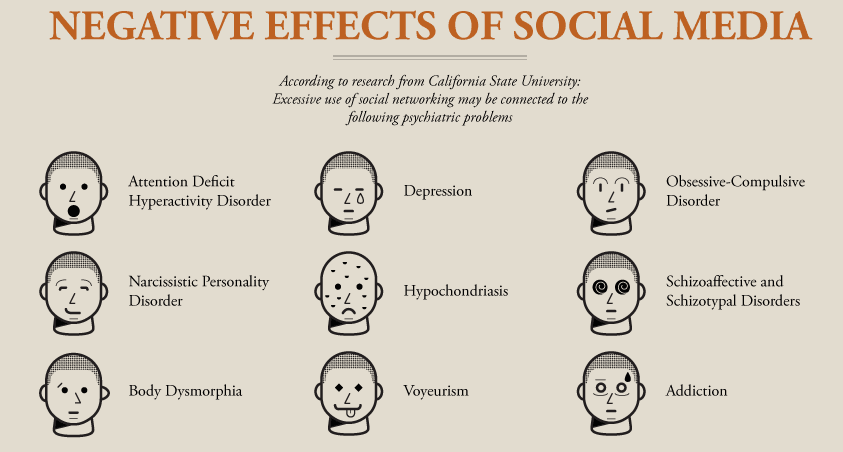
In most situations, usually the good outweighs the bad. However, when it comes to social media, the bad is starting to become greater and more relevant than the good. While social media platforms can be used for entertainment and keeping in contact with loved ones, it can also be used to cyberbully or shame someone. Individuals who do not meet the societal standards are often body shamed, ridiculed, outcasted, and harassed. When an individual is shamed online or harassed in any way online, they are more likely to develop mental health issues such as anxiety and depression. In most cases, many individuals have either attempted or have committed suicide due to online threats, comments, and distasteful post.

Putting a billion people on the internet also does not come risk free. There are dangers that may not be completely apparent. Exposure to elicit content, misinformation, bullying, sexual predators, and scammers.
Hall, Mark. "Facebook American Company." Britannica, 18 Oct, 2022 Facebook | Overview, History, & Facts | Britannica
"Facebook Statistics and Trends." DATAREPORTAL, The Latest Facebook Statistics: Everything You Need to Know — DataReportal – Global Digital Insights
Jones, Matthew. " The Complete History of Social Media: A Timeline of the Invention of Online Networking." History Cooperative, 16 June, 2015 History of Social Media: The Invention of Online Networking (historycooperative.org)
"Cyberbullying: What It Is, The Effects It Can Have On Teens, And Signs To Watch For." YouTube, Uploaded by Pfizer 12 Feb 2020, (1167) Cyberbullying: What It Is, The Effects It Can Have On Teens, And Signs To Watch For - YouTube
LaRocque, Conner. "This is your brain on social media." YouTube, Uploaded by TEDx Talks 27 March 2011, (1167) This is your brain on social media | Connor LaRocque | TEDxKanata - YouTube
Welton, Tanner. "Cell Phone Addiction." YouTube, Uploaded by TEDx Talks 10 Jun 2019, (1167) Cell Phone Addiction | Tanner Welton | TEDxLangleyED - YouTube
Oct 2016. www.lifeinthebaby.org, Alice-face-time-family-1-1.jpg (4032×2202) (lifeinthebay.org)
"Sharing too soon? Children and social media apps." National poll on children's health, C.S. MOTT CHILDRENS HOSPITAL, Sharing too soon? Children and social media apps | National Poll on Children's Health (mottpoll.org)
positive effects of social media - Bing images
selfie-syndrome-negative-effect-social-media.png (843×452) (bp.blogspot.com)
Fletcher, Jenna. "What Is Nomophobia." MedicalNewsToday, Feb 4, 2022. Nomophobia: Definition, causes, symptoms, and treatment (medicalnewstoday.com)
Nomophobia: NO mobile phone phobia. (n.d.). PubMed Central (PMC). https://www.ncbi.nlm.nih.gov/pmc/articles/PMC6510111/