


According to a study done by Healthy Minds which data was collected from 373 campuses nationwide, 60% of college students met at criteria for at least one mental health problem in 2020-2021. The high rate is due to coursework, relationships, COVID-19, and adjustments to campus life.
Student mental health is in crisis and colleges are rethinking their approach to dealing with mental health.
The most common mental illness among college students is an anxiety disorder. 11.9% suffer from the disorder. The next most common is depression. 7.9% suffer from this disorder.
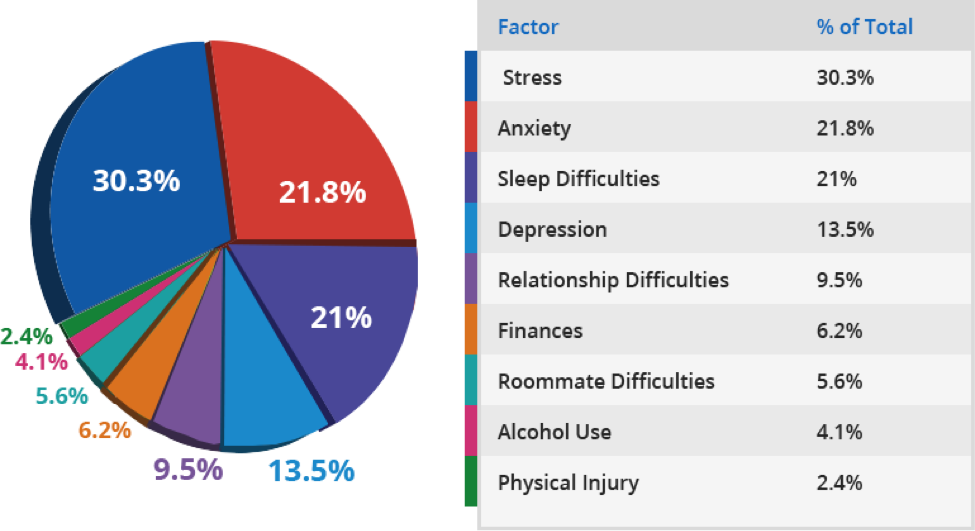
Below listed are some of the major symptoms a student may show if they are struggling with a mental health issue such as anxiety or depression.
The difficulty of schoolwork, changes in eating or sleeping patterns, sense of being overwhelmed, panic or panic attacks, lack of energy, and loss of interest in activities.
Showing negative thoughts or emotions, unusual short temper, quieter than normal, weight changes either losing or gaining, struggling financially, memory problems, or physical aches and pains.
Risk factors that could trigger a bout of depression or anxiety, or cause someone's mental health issues: Relationship breakups, a death in the family, sexual assault, health issues, drug or alcohol use, or family history of depression, anxiety, etc.
In 2018, it was reported that over half the population of college students struggled with mental health issues, such as depression or anxiety. Most of these students never faced these challenges and feelings, and struggle with knowing how to deal with them. Other classmates often do not recognize the symptoms of a depressed, overwhelmed student but seeing and learning some of the warning signs could help with getting the student the support they need.
Delta College has on-site counsel services with professionals licensed in the State of Michigan to provide confidential, free, and voluntary services.
Delta provides
-brief- short-term counseling with the goal to identify solutions and emphasize students’ strengths while collectively working together towards well-established goals
-crisis- aid students with support and help integrate coping skills. Often utilizing psychological first aid which in turn focuses on reducing acute distress.
-career- helps students have a better grasp on current and end goals for education and career. A counselor can help with the understanding, planning, and decision-making process.
Kalkbrenner, M., James, C., & Pèrez-Rojas, A. (2022, June). College Students' Awareness of Mental Disorders and Resources: Comparison across Academic Disciplines. Retrieved February 16, 2023, from https://eds.p.ebscohost.com/eds/detail/detail?vid=18&sid=4a13df25-9806-445f-96b2-4aec450a96e5%40redis&bdata=JnNpdGU9ZWRzLWxpdmUmc2NvcGU9c2l0ZQ%3d%3d#db=a9h&AN=157354792
“Managing Your Mental Health in College.” CORP-MAC0 (OCP), 11 Apr. 2022, https://onlinecounselingprograms.com/resources/mental-health-and-college-students/.
“National Library of Medicine - National Institutes of Health.” U.S. National Library of Medicine, National Institutes of Health, https://www.nlm.nih.gov/.
Reese Druckenmiller, L. I. C. S. W. (2022, December 7). College students and Depression. Mayo Clinic Health System. Retrieved February 22, 2023, from https://www.mayoclinichealthsystem.org/hometown-health/speaking-of-health/college-students-and-depression
“Student Mental Health Is in Crisis. Campuses Are Rethinking Their Approach.” Monitor on Psychology, American Psychological Association, https://www.apa.org/monitor/2022/10/mental-health-campus-care.